







If you’re interested in becoming an equestrian and riding dressage, you are likely trying to understand how dressage fits into the bigger picture of riding and how it can actually help you and your horse. The good news is that dressage is not just for advanced riders or specific breeds. It is a training system that works for all horses and riders, helping you develop better balance, clearer communication, and more confidence in the saddle.
At its core, dressage is about building correct basics. It teaches your horse to move with more balance and suppleness, and it teaches you how to ride with more clarity and purpose.
What Is Equestrianism and How Does Dressage Fit In?
Equestrianism refers to the art, sport, and practice of riding, training, and working with horses. It includes a wide range of disciplines such as jumping, eventing, trail riding, and dressage. At its core, equestrianism is about developing a skilled, balanced rider and a well-trained, responsive horse.
Within equestrianism, dressage plays a central role. Often described as the foundation of all riding, dressage focuses on improving communication, balance, and harmony between horse and rider. This is why the term equestrianism dressage is sometimes used to describe the connection between general horsemanship and the structured training system that dressage provides.
No matter which discipline you pursue, the principles of dressage are always present. Riders who invest time in dressage within their equestrian journey develop better control, more effective aids, and a deeper partnership with their horse.
In simple terms, equestrianism is the big picture of riding, and dressage is the training system that helps you do it well.
The Foundation of Equestrianism
Dressage is often considered the foundation of all riding because it improves the basics of communication and trust that every horse and rider needs.
Without dressage training, riders often struggle with tense nervous horses, inability to turn, horses that are too fast and too slow, inconsistent contact, poor transitions, and crookedness. Dressage provides a clear, step-by-step system to fix these issues.
Riders across all disciplines benefit from dressage work. Whether you trail ride, jump, or simply want a better connection with your horse, dressage gives you the tools to improve.
How Equestrians Use Dressage to Improve Their Relationship with their Horse
One of the biggest benefits of dressage is how it develops your horse physically and mentally over time.
Through correct, consistent training, your horse becomes:
- more supple through the body
- rounder through their topline
- more balanced and uphill
- straighter and more aligned
- more responsive to light aids
Even horses with average movement can improve significantly with correct dressage training. The key is not forcing a frame, but developing the horse from back to front.
How All Equestrians Can Benefit From Dressage
Dressage is just as much about developing the rider as it is about developing the horse.
Many equestrian issues come back to rider position and timing. Riders often tip forward, grip with the leg, brace in the arms, or sit crooked without realising it.
Dressage teaches you to:
- sit in balance with an ear-shoulder-hip-heel alignment
- develop an independent seat
- maintain a steady contact from elbow to the horse’s mouth
- apply clear, consistent aids
As your position improves, your horse’s response improves as well. This creates a more confident and effective partnership.
The Dressage Training Scale: The Real Basics Every Rider Needs to Master
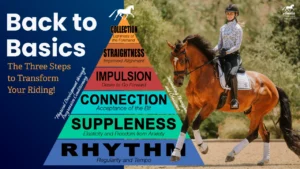
The training scale is a step-by-step system that guides your training. Start at the bottom of the training scale and work your way towards the top. The majority of your time should be spent on the base of the training scale – rhythm, suppleness, and connection. Once you feel the base of the scale is solid, then start adding in more levels. It takes many years of training to reach the top and attain true collection. The more solid the base of the training scale, the easier it will be to develop your horse and move up the levels.
As you go through your ride, whenever you have an issue with your horse or you get stuck in an exercise, use the training scale to troubleshoot and help you find the root cause of your problem. The training scale is your guide to every single ride.
Always spend the MOST TIME working on the base of the training scale – rhythm, suppleness,
and connection.
Rhythm
Rhythm is the foundation of everything. Each gait should have a clear rhythm and a steady, active tempo. Counting out loud is one of the best exercises to help you with your rhythm.
Suppleness
Suppleness means both physical and mental relaxation. A tense horse cannot learn effectively. A supple horse can move freely and begin to develop strength.
Connection
Connection is the flow of energy from the hind leg, through the back, into the contact. It is not about pulling the horse’s head in. It is about creating energy that travels forward into a steady hand.
These first three levels of the training scale are the true basics. When they are correct, everything else becomes easier.
What Should a Beginner Rider Focus On?
If you are just starting out, keep it simple and focus on the fundamentals.
First, focus on your rider position. A balanced position allows you to give clear aids and stay in harmony with your horse.
Second, make sure your horse is forward and responsive to the leg. Forward energy is essential for developing balance and connection.
Third, ride simple figures like the 20-meter circle. This helps establish rhythm, balance, and consistency.
Finally, have a plan for your ride. Structure helps you stay focused and make progress.
How Dressage Improves Transitions and Control
Transitions are one of the most important tools in dressage. They show whether your horse is balanced, responsive, and connected.
Good transitions should feel smooth, prompt, and organized. If they feel rushed or heavy, that is a sign something needs improvement.
Working on transitions helps improve your horse’s responsiveness and balance quickly.
Common Dressage Mistakes That Impact All Areas of Equestrianism
Many riders make similar mistakes when learning dressage.
One mistake is focusing too much on the horse’s head and neck. Real connection starts from the hind leg, not the front end.
Another mistake is nagging and over-riding every stride. Dressage should involve clear aids followed by a release of the pressure.
A third mistake is skipping the basics. Riders often want to move on to advanced work before the foundation is solid.
How to Build Progress Without Feeling Overwhelmed
Dressage becomes much easier when you think of it as a training system rather than a performance.
Focus on one or two priorities per ride. For example, you might work on rhythm and suppleness one day, and transitions the next.
Check in with your position regularly. Take a breath, sit deep, and reset when things feel off.
Most importantly, be patient. Dressage is a process of building strength, understanding, and communication over time.
It’s About Partnership, Not Perfection
Dressage is not about getting everything perfect. It is about building a partnership with your horse.
There will be challenging rides and slow progress at times. That is normal. But with consistent, correct training, your horse becomes more responsive, more balanced, and easier to ride.
Those moments when everything feels connected and effortless are what dressage is all about.
FAQs About Equestrianism and Dressage
Is dressage only for advanced riders?
No. Dressage benefits equestrians at every level. It provides a clear system for improving the basics of riding your horse.
Do I need a special horse for dressage?
No. Any horse can benefit from dressage training.
What is the most important thing to learn first?
Focus on rhythm, suppleness, and forward energy. These create the foundation for everything else.
Can dressage help with confidence?
Yes. A more responsive and balanced horse leads to a more confident rider.
How often should I practice?
Consistency is key. Regular, focused rides will lead to steady improvement.
Both equestrianism and dressage are lifelong pursuits, it’s not about riding perfectly every time. It is about developing a better connection with your horse through clear, consistent training. When you focus on the basics and build your skills step by step, you create a horse that is more balanced and a ride that feels more confident, calm, and connected.