











Last Updated: 4/23/2026
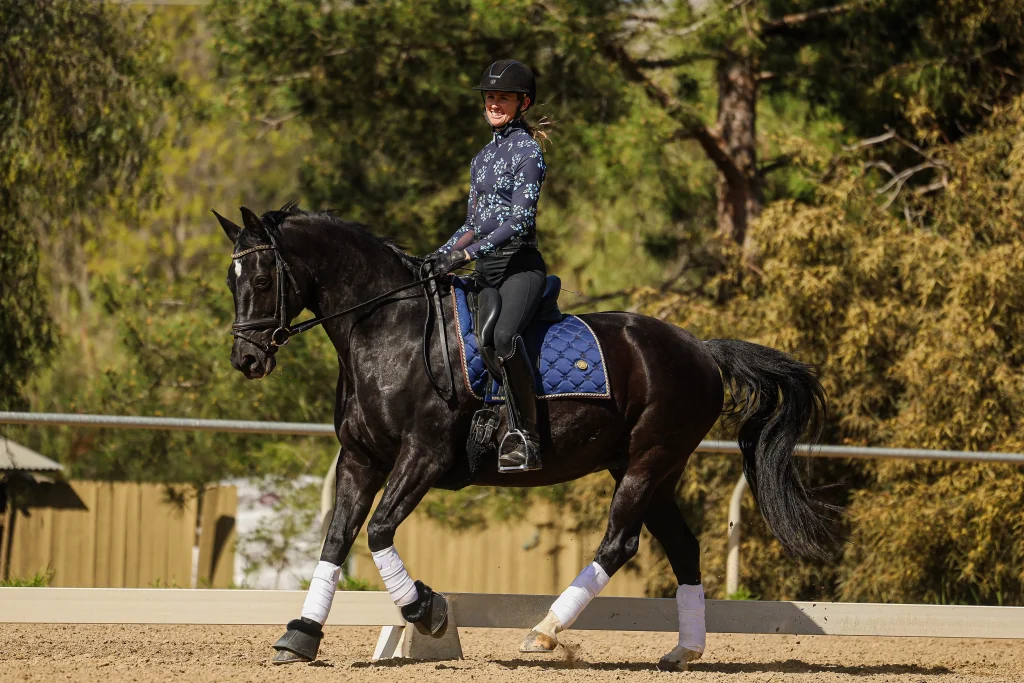
If cantering feels fast, powerful, and even a little intimidating, you are definitely not alone.
For so many riders, the canter is the gait where everything suddenly falls apart. You may feel secure in the walk and trot, but the moment it’s time to canter, it can be easy to tip forward, stiffen up, and lose your confidence.
In this video, I’m walking you through a step-by-step guide to cantering so you can better understand the movement, stay with your horse, and feel more secure in the saddle. And if you need extra help, I also have a free PDF with five exercises to do before you canter, which is a great way to make sure you have the right foundation in place. Get the free guide here.
Ok, now on to the tips!
Why the Canter Feels So Different
The first thing to understand is that the canter is very different from the walk and trot.
In the walk and trot, your horse’s back stays more level. But in the canter, your horse’s back moves more like a wave. There is an up, level, down feeling that creates a much bigger swinging motion through your horse’s body.
That wave-like motion is one reason the canter can feel so challenging at first. There is more power, more movement, and often more speed, which can make riders feel nervous. But once you understand the motion and learn how to follow it, the canter starts to feel much more natural.
Step One: Keep Your Shoulders Back
One of the most important things when you ask for canter is to keep your shoulders back.
This is such a common mistake. Riders can be going beautifully in the trot with good alignment, sitting tall and balanced. Then the moment they think “canter,” they lean forward and throw themselves ahead of the motion.
The problem is that leaning forward makes you much less secure. It puts you in a position where you are more likely to get thrown around by the movement, especially if your horse goes faster, turns suddenly, or gets playful.
Step Two: Let Your Hips Follow the Swing
Once you are sitting back, the next challenge is learning how to move with the canter.
Because the canter is like a wave, your hips need to swing with that motion. Think of your hips moving from back to front, in the saddle.
Your upper body should stay quiet and steady, while your hips softly follow the movement underneath you.
This is where many riders get stuck. Instead of following, they stiffen in their hips and lower back. When that happens, they start bouncing or almost “posting” in the canter, which makes it much harder to stay connected.
Step Three: Use Soft, Following Elbows
Your elbows are just as important as your seat in the canter.
Because of the wave-like motion of the gait, your horse’s neck naturally oscillates forward and back. That means your elbows need to softly bend and straighten to follow.
If your arms lock, the contact becomes restrictive. Instead of a steady connection, you get a pulling and giving effect on the reins. Most horses respond to that by becoming stiff, breaking gait, or rushing forward.
Soft elbows help you stay connected without interfering. They allow your horse to use their neck naturally, which helps the whole canter feel smoother and more relaxed.
Understanding the Canter Rhythm
The canter is a three-beat gait, and understanding that rhythm can make a big difference.
In this video, I break down the feeling of the stride so you can better understand what your body should do.
- On beat one, your seat is farthest back in the saddle, your horse is coming up in front of you, and your elbows are the most bent.
- On beat two, everything feels a bit more level.
- On beat three, your shoulders are more back, and your elbows straighten a little more and your seat moves to the front of the saddle.
You do not need to overcomplicate this when you ride, but understanding that the canter has a distinct three-beat pattern helps you start to organize the motion in your body.
That is why counting can be so helpful. Counting gives your mind something simple to focus on and helps you tune into the movement of the gait.
It can also help you coordinate your body more clearly. As you count, you may start to notice your hips swinging, your elbows following, and the overall rhythm becoming easier to understand.
For many riders, this is one of the best ways to start finding the feel of the canter.
Don’t Forget to Breathe
My final tip is to breathe.
This sounds simple, but it matters so much. When riders get nervous about cantering, they often hold their breath without realizing it. The moment you hold your breath, your body tightens, your shoulders creep forward, and it becomes much harder to move with your horse.
Breathing helps you stay soft, balanced, and present.
So if the canter starts to feel overwhelming, come back to your breath. Exhale. Let your body soften. Then allow the motion to carry you.
If cantering feels challenging right now, keep going. This is a gait that takes time to understand, and that is completely normal.
The more you can visualize the movement, practice the rhythm, and learn to follow with your body, the more comfortable and confident you will become. Be patient with yourself, stay soft, and remember that learning the canter is a process.
You will get it. Sometimes you just need to take the time it takes.
Happy Riding!
Amelia
P.S. If you want extra help preparing for canter, be sure to check out my free PDF with five exercises to do before you canter. It is a great resource to help you build confidence, improve your setup, and feel more ready for the transition. Download the free guide here.