

















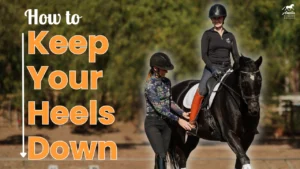
If you’ve ever been told to “push your heels down” while riding, you’re definitely not alone. Keeping your heels down is important not only for your balance but also for communicating effectively with your horse. But keeping your heels down isn’t just about forcing them lower—it’s about finding the correct position for your foot in the stirrup, and creating better balance through your entire body. A lot of riders try to force their heels down without understanding how the rest of the body works together, which usually creates more tension and instability instead of improving their position.
In this video, I’m breaking down the most common mistakes riders make with their foot position in the stirrup, how it affects their rider position, and a simple three-step process to help you finally keep your heels down correctly. Sometimes, small adjustments in your foot and leg position can completely change how secure and balanced you feel in the saddle.
Before we dive into the tips, if you struggle with keeping your heels down, losing your stirrups, or feeling unstable in the saddle, my free Independent Seat Webinar would be a great next step for you. In the webinar, I walk you through how to improve your balance, stability, and overall rider position so you can feel more secure and connected with your horse.
Why Your Stirrup Foot Position Matters
Your foot position in your stirrups is incredibly important because your legs are one of the main ways you communicate with your horse. If your leg is constantly gripping, clamping, or nagging, your aids become less effective, and your horse can become dull to your leg.
Your heels and ankles also act as shock absorbers while you ride. When your heels are stiff or pulled up, your seat gets blocked, and you start bouncing in the saddle. A correct foot position allows your body to move with the horse more naturally and helps create a stronger, more stable foundation in the saddle. When your foot and ankle are relaxed and elastic, it becomes much easier to maintain good balance and harmony with your horse.
Common Rider Stirrup Foot Positioning Mistakes
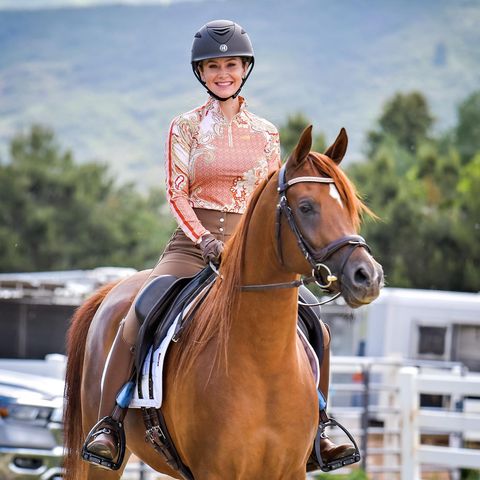
One of the biggest mistakes riders make is jamming their heels down. This often pushes the rider into a chair seat, stiffens the leg, and actually makes your rider position on your horse less effective. Riders often think they need to force their heels lower. Instead, just think of letting your legs drape around the horse and let the weight of your leg rest in the stirrup.
Your heel should have a light, elastic “bounce” that absorbs motion naturally instead of forcing the position. When your leg is relaxed and secure, your entire rider position becomes much more effective.
Check Your Stirrup Foot Positioning and Stirrup Length
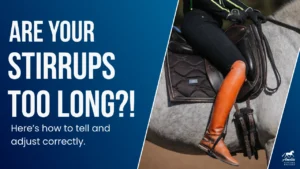
Before anything else, make sure your stirrups are the correct length. If your stirrups are too long or too short, it becomes much harder to maintain the correct foot position in your stirrups and a balanced leg.
A good guideline is that the bottom of the stirrup should sit around your ankle bone when your feet are out of the stirrups. Of course, stirrup length can vary slightly depending on your discipline and personal preference, but having an appropriate starting point makes a huge difference in your overall balance and security.
When your stirrups are the correct length, it becomes much easier to allow your leg to drape naturally underneath you without gripping or bracing. A lot of riders either put way too much weight into their stirrups or not enough. Both extremes can create instability and tension in the body.
In this video, I demonstrate how to experiment with both extremes so you can find the correct middle ground. Ideally, the stirrup should sit across the ball of your foot with the weight of your leg dropping naturally into the stirrup. You shouldn’t feel like you’re standing in your stirrups, but you also shouldn’t feel disconnected from them.
When this happens correctly, your rider position becomes much more stable, relaxed, and effective. You’ll feel more secure in the saddle and better able to follow your horse’s movement.
Improve Your Rider Position with Transitions
Transitions are one of the best ways to improve your position and get your heels down, because they encourage your leg to become more stable and effective without gripping.
Simple walk-trot or trot-walk transitions help teach your horse to respond to your calf without constant nagging. The goal is for your horse to react from a light aid, so you don’t feel the need to grip with your leg or lift your heels in an attempt to create more control.
As you ride the transition, think about allowing your heels to stay softly down and elastic instead of forcing them. Over time, this helps create a much stronger and more balanced rider position.
Correct foot position in your stirrups is really about balance, flexibility, and relaxation—not forcing your heels down. When riders stop trying to create the position through tension and instead focus on balance and elasticity, everything starts to work better together.
When your stirrup and rider position improve, your entire position becomes more effective, secure, and connected to your horse. And the best part is that when your position improves, your horse usually improves right along with you.
Happy riding!
Amelia
P.S. If you want more help improving your balance and stability in the saddle, don’t forget to sign up for my free Independent Seat Webinar. I’ll walk you through simple exercises and concepts to help you develop a more secure, effective rider position so you can ride with more confidence and harmony.