






Dressage Competition & Test Riding: How to Ride Your Best Test
Competing in dressage can be exciting, challenging, and yes—nerve-wracking! Whether you’re getting ready for your first Training Level test or polishing your ride at Second Level, understanding how the tests are designed, what judges are looking for, and how to prepare both mentally and physically can make all the difference.
In this video, I walk through everything you need to know about dressage competition—from what’s expected at each level, to how tests are scored, and how to create calm, confident rides on show day.
Why Compete (or Not)?
You don’t have to compete to benefit from learning about the dressage tests. Even if you prefer to stay at home, reading through the tests and understanding how they build from one level to the next will help you structure your training and give you new exercises to work on.
Competition is simply a way to measure your progress—to see how your training is coming along under pressure. But even if you never step into the show arena, the test structure itself is a fantastic training guide.
Understanding the Levels
Let’s go through the levels step-by-step. In the U.S., we have Training through Fourth Level, and then the FEI levels (Prix St. Georges, Intermediate I & II, and Grand Prix). Each level builds on the one before, introducing new movements and expecting greater balance, collection, and harmony.
Training Level
Purpose:
To confirm that the horse demonstrates correct basics—moving forward in a steady rhythm, supple and relaxed, and accepting the contact.
At this level, judges are looking for:
- Clear rhythm in all gaits
- Relaxation and suppleness
- A steady connection to the bit
- Willingness and confidence
You can ride sitting or rising trot at Training Level. I generally recommend rising trot—it allows the horse’s back to move more freely, which helps green horses and riders stay relaxed and rhythmic.
Think of contact as holding a child’s hand: there’s connection, but it’s soft and steady—not tight or pulling.
First Level
Purpose:
To confirm that the horse maintains correct basics while developing thrust and showing more balance and throughness.
At this stage, you’ll see the introduction of:
- Lengthenings in trot and canter
- 10-meter circles at trot
- Change of lead through trot
- Counter canter
Thrust and impulsion are key here—your horse should begin to show more power from the hind legs, with greater suspension and freedom through the shoulders.
A great way to prepare is to ride transitions within the gait—from working trot to a more forward trot, then back again. This builds strength, balance, and the beginnings of collection.
Second Level
Purpose:
To confirm that the horse now accepts more weight on the hindquarters, showing collection, self-carriage, and increased straightness and throughness.
You’ll introduce:
- Collected trot and canter
- Shoulder-in, haunches-in
- Rein back
- Counter canter
- Simple changes (walk–canter–walk)
This is a big step up from First Level. Collection doesn’t just mean shorter strides—it means the horse is sitting more behind, carrying more weight on the hind legs, and becoming lighter in the front.
If your horse tends to shorten or tighten the neck, focus on engaging the hind legs rather than pulling the neck shorter. Ride shoulder-in or lateral work to activate the inside hind leg, then allow the neck to lengthen forward into the contact.
Third Level
Purpose:
To confirm that the horse demonstrates increased engagement and self-carriage, with extended paces and flying changes introduced.
New movements include:
- Extended trot and canter
- Half pass at trot and canter
- Flying changes
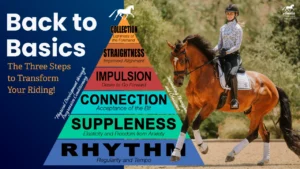
This is where the training scale really comes together—rhythm, suppleness, contact, impulsion, straightness, and collection all play a role in every movement.
And remember, progress takes time. On average, expect to spend about a year per level if you’re training consistently five days a week. Dressage is a marathon, not a sprint.
How Tests Are Scored
Each movement in your test is scored from 0 to 10, with half points allowed.
- 6 = satisfactory
- 7 = fairly good
- 8 = good
- 9 = very good
- 10 = excellent
A 60% is considered a solid, qualifying score—so don’t be discouraged if you’re not in the 70s yet!
Key Test-Riding Skills
1. Transitions Are Everything
At Training Level, 9 of the 15 movements involve transitions. Smooth, prompt transitions show connection, obedience, and preparation. Practice them daily.
2. Ride Your Corners
Corners set up your next movement. Use them to half-halt, rebalance, and prepare. At lower levels, don’t ride too deep into the corners if your horse isn’t balanced yet—but gradually increase depth as you move up the levels.
3. Memorize Your Test
Even if you have a reader, know your test. Your horse feels your confidence and preparation.
4. Have a Mistake Plan
If something goes wrong—like missing a lead—fix it quickly, regroup, and move on. Judges value composure and correct recovery.
5. Warm Up Like at Home
Your warm-up isn’t for training—it’s for reminding your horse of what they already know. Keep it familiar, positive, and simple.
Preparation and Mindset
Before the Show
- Practice your test in sections, not endlessly from start to finish.
- Visualize your ride—including what you’ll do if something goes wrong.
- If possible, school your horse in the show ring the day before.
On Show Day
- Arrive early and stay calm.
- Stick to your usual warm-up routine.
- Breathe and ride for your horse, not the crowd.
- Don’t compare yourself to others—ride your own best test.
After the Test
- Read your scores and comments carefully.
- Look for repeated feedback—those are your biggest learning opportunities.
- Set small goals for your next show, like improving halts or transitions.
And remember: not every horse can score a 9 on extended trot, but every horse can have accurate geometry, relaxation, and rhythm. Ride for those easy points!
Compete with Yourself
Dressage is a sport of personal progress. Your goal should be to have a better ride than last time—to be more connected, more relaxed, and more harmonious with your horse.
Not every horse has big gaits, and that’s okay. Success in dressage comes from correct training, kindness, and consistency—not just movement quality.
Final Thoughts
Showing takes courage. It means putting yourself out there and being okay with imperfection. Every mistake is a learning opportunity, and every test is a chance to grow.
So whether you’re showing Training Level or schooling Grand Prix, ride with pride, enjoy your horse, and remember—you’re doing this because you love it.
Ready to go deeper?
Check out my Masterclasses for Training Level, First Level, and Second Level, where I ride through each test, explain the directives, and show you exactly how to train the exercises judges want to see.