




Dressage is hard and lessons are the best way to improve your riding quickly, but it is important that you understand what makes a good lesson and how to make the most of each lesson you have and each moment you spend in the saddle. Dressage comes from the French word dresser, which means to train or prepare. At its core, dressage is about training the horse and rider to move in balance, harmony, and to develop clearer communication. A good dressage lesson should give you confidence by teaching you new exercises and giving you a simple plan and focus for your next ride.
But here’s the problem… many riders finish a lesson feeling motivated, then get back on a few days later and think, “What was I supposed to work on again?” That is where progress starts to get fuzzy.
Good dressage lessons are not about surviving 45 minutes of correction. They are about building correct basics, understanding your horse better, and learning how to make each ride count.
What Are Dressage Lessons, Really?
Dressage lessons are structured training sessions that improve how horse and rider communicate. A good dressage lesson should help you improve your position, your aids, your horse’s balance, the quality of the gaits, and the consistency of the transitions.
More than that, a good lesson should help your horse become more supple, more responsive, and easier to ride.
If the lesson is good, you should not leave feeling confused or frustrated. You should leave with one or two clear priorities, new exercises, confidence, and a better understanding of what your horse needs.
What Should You Expect From Dressage Lessons?
You should expect dressage lessons to help you ride with more clarity and help your horse go better through correct basics. Your dressage lesson should include a thoughtful warm-up, a focused working phase, and several different exercises. They should improve rhythm, connection, straightness, responsiveness, and rider effectiveness. You should leave knowing what to practice and why it matters.
Why Dressage Lessons Matter
Dressage lessons matter because they tell you what you don’t know and are not aware of. Sometimes what you feel is very different from what you see and you may have developed habits that you are unaware of. Dressage lessons can get you unstuck and help move you up to the next level.
Are you tipping forward or riding in a chair seat?
Is your horse in front of the leg?
Is your horse hollow and above the bit?
Are your aids clear, or are you nagging?
Those details change everything and without lessons you may be unaware of your problems.
A good dressage lesson helps you separate symptoms from causes. If the canter transition is messy, the real issue may be tension, crookedness, poor preparation, or a rider who tips forward and loses balance. If the horse feels heavy in the hand, the answer is usually not stronger rein aids. More often, the problem goes back to balance, reaction to the leg, suppleness, and clarity in the rider’s aids.
That is why dressage lessons are so useful for riders in every discipline. They improve the foundation and help you identify the root cause of the problem you’re experiencing.
What Happens in Good Dressage Lessons?
Good dressage lessons usually follow a clear progression and a focus on rider position and the basics. That structure, along with positive and clear instructions from the coach, is one of the reasons they work so well.
Dressage Lessons Should Start With a Purposeful Warm-Up
Give yourself time before your lesson to settle your horse with a bit of groundwork if needed and a good 10-15 minutes of walking. Most Dressage instructors will help you warm up and offer suggestions on the best exercises for you and your horse.
A good warm-up often includes bending lines, large circles, and simple checks on rhythm, steering, and your own position. At this stage, the trainer is also assessing the starting point for that day.
Some days your horse needs more energy. Some days your horse needs more relaxation. Some days the warm up may take longer than others. A good lesson starts with the horse you have that day, not the one you hoped to bring out.
This kind of structure fits closely with my approach to teaching and planning guides.
Dressage Lessons Should Focus on a Few Clear Goals
Once the horse is prepared, the lesson should narrow down to a small number of meaningful goals.
That might be:
- Focusing on rider position
- Teaching the horse to be more responsive to the leg
- Improving transitions
- Developing a steadier contact
- Improving suppleness
This is where good dressage lessons stand out from random schooling. You are not just riding around and trying things. You are riding with a plan and solving the most important problem first.
The best lessons stay focused on the correct basics and clear exercises. If you try to fix everything in one ride, you usually fix nothing. If you improve one clear thing and understand why it improved, that progress tends to last.
What to Focus on During Dressage Lessons
There are a few themes that come up again and again in effective dressage lessons. These are the things that tell you whether the work is actually improving the horse.
Why Rider Position Matters When Learning Dressage
Your position affects everything because your horse is your mirror.
If you are crooked, gripping, bracing, or collapsing in your body, your horse cannot move freely underneath you. Therefore your position is always part of the training conversation and a good riding instructor should help you to improve and identify what to fix in your rider position.
Correct rider position helps you:
- follow the motion
- sit more quietly
- give clear aids
- stop blocking your horse
This is one reason riders make such fast progress in lessons. A trainer can often spot position habits that you cannot feel.
How Dressage Lessons Improve Rhythm, Balance, and Connection
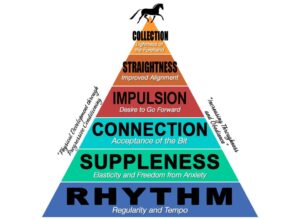
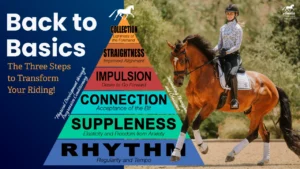
Rhythm is the base of the Dressage Training Scale. It is the foundation of every single ride. A good instructor will always start with rhythm and finding the ideal tempo for your horse. It is essential that the horse and rider are in sync and riding in the correct rhythm before you start with movements.
Your Dressage instructor should help you to:
- Identify and feel the rhythm
- Decide if your horse is too slow or too fast
- Improve the rhythm and gaits through suppleness and connection exercises.
Many of my teaching resources come back to these basics again and again. One of the biggest things riders struggle with is How to Create Steady, Soft Contact with your Horse. The first step to establishing a soft steady contact is rhythm, believe it or not!
Why Transitions Tell the Truth in Dressage Lessons
Transitions are one of the best tools in dressage lessons because transitions are where the training happens. So much can go wrong during a transition – head up, no response, crooked, curling, ect.
They reveal whether the horse is in front of the leg, whether the rider is organized, whether the horse is truly on the bit, and whether the horse is engaged and using their hind end.
That is why so many lessons circle back to walk-trot, trot-canter, and transitions within the gait. They improve responsiveness, balance, and clarity all at once.
How to Make Every Dressage Lesson Count
The riders who improve the fastest are usually not the ones who take the most lessons. They are the ones who apply their lessons well.
When Learning Dressage Listen for the Main Idea
Focus on each word your trainer says. Try to listen for the main point of the lesson.
Maybe the whole ride really comes down to getting your horse more in front of the leg. Maybe it is about riding straighter to the outside rein. Maybe it is about staying softer in your body.
When you catch the main idea, the whole lesson starts to make more sense. It is also ok to ask questions, and ask your trainer to explain what they mean.
After Your Dressage Lesson, Write Down the Homework
It is easy to forget everything you learn. After the lesson, write down:
- the main problem you worked on
- the exercise that helped most
- the feeling you want to find again
That last one matters a lot. Riders often remember the exercise but forget the feeling. The feeling is usually what disappears first. It is great if you can visualize and imagine this feeling again in your body and mind. Believe it or not, visualization really does help you to make the most of your limited time in the saddle!
Before Your Next Dressage Lesson, Review What You Are Working On
Before you get on, remind yourself what you worked on in the last lesson.
What was the main issue?
What exercise helped the most?
What feeling are you trying to recreate?
That simple review keeps you from starting each ride from scratch.
Can You Improve With Online Dressage Lessons and Courses?
Yes, you absolutely can improve with online dressage lessons and courses, and often learning online can be MORE effective than in person lessons because you are not multitasking riding a horse and you can focus and absorb the concepts.
In-person lessons are valuable because a trainer can give immediate feedback in real time. Online learning helps in a different way. It gives riders more theory, more repetition, more visual learning, and more opportunities to review the material at their own pace.
Did you know that you can learn to ride dressage online with Amelia’s programs? Her programs are designed to help riders build correct basics, understand the “why” behind the exercises, and keep improving between formal lessons.
There are also some real advantages to learning online.
Can You Learn Dressage Lessons Online?
Online dressage training is quickly growing in popularity and gives you access to quality training without having to travel long distances or coordinate schedules around in-person rides.
You can revisit lessons when you need them. You can watch before you ride, after you ride, or both. In fact, most people are amazed by how quickly they can learn to ride dressage with online training.
Online Dressage Courses Help Riders Become More Independent
Online learning asks more of the rider in a good way.
You have to take responsibility for what you are doing. You have to identify training issues, review the material, take it to the barn, and come back with questions. That kind of responsibility often makes riders sharper and more proactive.
It also gives you more time to absorb theory. In a normal lesson, you are busy riding. Online courses make it easier to slow down and understand concepts like rhythm, connection, roundness, transitions, and the training scale.
Community Support Helps Riders Stay Consistent
One reason riders do well in programs and online communities is that support matters. It is easier to stay motivated when you have a place to ask questions, share progress, and learn alongside other riders working through similar problems.
Why Filming Your Rides Makes Dressage Lessons More Effective
One of the best ways to get more from your dressage lessons is to film your rides.
Video is powerful because it helps you connect what you feel in the saddle with what is actually happening. Many riders think they are sitting straight, riding forward, or keeping a steady contact and a round frame, then they watch the video and realize the picture is different.
That awareness is incredibly useful.
When you film your rides, you can:
- review your position
- check your horse’s frame
- see whether your transitions stay balanced
- compare your riding and progress over time
Is a PIVO Worth It for Practicing Dressage?
If you ride alone, a Pivo can make filming much easier.
It lets you capture your rides without needing someone to stand at the rail with your phone. That means you can film more often, review more often, and make better plans for the next ride.
The icing on the cake is that you can set your PIVO up in under an hour, so you’ll be on your way to better dressage in no-time.
Common Mistakes That Make Dressage Lessons Less Effective
A few habits can make dressage lessons much less useful.
Trying to Impress the Trainer
When riders try to make everything look good, they often ride with too much tension and too much pressure. The point of dressage is that you do less and your horse does more. Remember to breathe, relax. It is ok to make mistakes,
A lesson is not a performance. It is a place to work honestly.
Trying to Fix Everything in One Ride
This usually leads to frustration. Stay focused on one or two priorities. That is how progress sticks.
Leaving Without a Clear Plan
If you do not know what the main takeaway was, pause and ask yourself one simple question:
What made the biggest difference today?
That is usually where your homework starts.
Dressage Lessons FAQ
How Often Should You Take Dressage Lessons?
That depends on your goals, budget, and how well you practice between lessons. One good lesson a week can create a lot of progress. Even two lessons a month can help if you ride thoughtfully in between.
Are Dressage Lessons Only for Dressage Riders?
No. Dressage lessons help riders in every discipline because the basics apply everywhere. Better balance, straighter lines, clearer aids, and smoother transitions help all horses and riders.
What If My Horse Gets Tense in Dressage Lessons?
Then the lesson needs to meet your horse where he is. Slow down, simplify, and focus on rhythm and relaxation before asking for more.
Should I Write Notes After Dressage Lessons?
Yes. Write down the main issue, the best exercise, and the feeling you want to recreate. That makes it much easier to ride productively between lessons.
Can Online Dressage Lessons Replace In-Person Lessons?
For many riders, the best answer is a combination. In-person lessons provide immediate feedback. Online learning gives you structure, theory, and support between rides.
Final Thoughts on Dressage Lessons
The best dressage lessons are not the ones with the most complicated exercises. They are the ones that make your riding clearer and your horse easier to understand.
They help you improve the basics, focus on what matters most, and leave with a plan instead of a blur.
If you approach dressage lessons that way, you get more than corrections. You get real training. And that is what leads to better rides, more confidence, and a stronger partnership with your horse.