





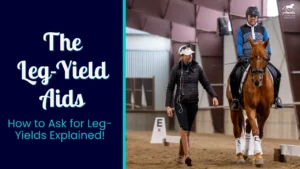




If you’ve ever struggled with the leg yield, you’re not alone. Many riders find it challenging to coordinate the aids, keep their horse straight, and maintain a steady rhythm through the movement. The good news is that with the right knowledge, the leg yield becomes much easier to understand and ride. In this video, I’ll walk you through the aids, common mistakes, and a few simple exercises that will help improve your leg yields and build a more supple, balanced horse.
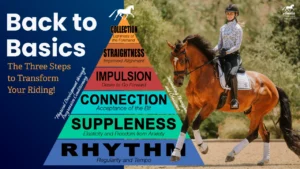
Before we dive in, if you’re ready to make real progress with your riding this fall, be sure to join my Back to School Bootcamp. It’s time for back to school, back to basics, and back to loving your horse. Riders LOVE Bootcamp; check out the schedule I have planned for you:
This program is completely free, and everyone who is passionate is welcome to join us. All you have to do is register.
Ok and now on to this week’s video.
Why the Leg Yield Matters in Dressage Training
The leg yield is one of the first lateral movements you’ll learn in Dressage, it is introduced at First Level. It’s a forward and sideways movement where your horse’s body stays parallel to the long side while crossing its legs.
This exercise is valuable because it develops suppleness while encouraging your horse to become straighter and more even on both sides. Like every exercise in dressage training, it’s about improving the quality of the basics rather than simply completing the movement.
Before asking for a leg yield, make sure your horse is moving forward in a steady rhythm and is moving into the contact. Those basics make everything else much easier.
The Aids for a Better Leg Yield
A successful leg yield comes from balancing your inside leg with your outside rein. After turning onto the quarter line or centerline, establish straightness before asking your horse to move sideways.
Your inside leg asks the inside hind leg to step across, while your outside rein controls the outside shoulder and keeps your horse parallel to the long side. Think about riding from your inside leg into your outside rein. As your horse begins to understand this connection, the movement becomes smoother and more balanced.
One of the biggest mistakes riders make is letting go of the outside rein. When that happens, the horse often falls through the outside shoulder and speeds up instead of stepping sideways with control.
Exercises to Improve Your Leg Yield
One of my favorite exercises is the leg yield staircase. Leg yield a few steps, ride straight, then leg yield again. Alternating between moving sideways and straight ahead helps both the horse and rider stay organized and prevents drifting.
It’s important to practice the leg yield in both directions. Every horse has a stronger and weaker side, and you’ll often notice different challenges depending on which direction you’re traveling. If your horse struggles to connect from your inside leg to your outside rein, a slight inside flexion can sometimes help the shoulders begin to move more freely while maintaining the correct connection.
As your horse gains confidence, test your connection by softening the inside rein for a moment. Ideally, your horse should remain balanced from your inside leg to your outside rein without falling apart.
The leg yield takes time to develop, so be patient. Change directions often, mix in some forward riding if your horse becomes frustrated, and remember that every quality repetition builds better suppleness, connection, straightness, and symmetry.
Happy Riding!
Amelia
P.S. My Back to School Bootcamp is free to attend and is five days of packed-full education. If you’re ready to take your riding to the next level, you don’t want to sit this one out. Riders love Bootcamp because it’s all about developing partnership and connection with their horses.