





















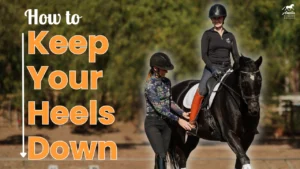
Your foot position in your stirrup has a big effect on how secure you feel in the saddle and how clearly you can use your leg aids. If your stirrups keep slipping, your lower leg swings, or you ride with your shoulders back and your legs pushed forward, your stirrups may simply be too long.
In this video, I show you how to check your stirrup length, position your foot correctly, and use your ankles to become more balanced and effective when you ride.
Before we dive in, I want to invite you to my free 5 Day Back-to-School Riding Bootcamp, this August 26th-30th. If you need help getting back to basics and back to loving your horse, then this bootcamp is for you!
Ok, now on to the video!
Signs Your Stirrups Are Too Long
Many riders think longer stirrups automatically create a better Dressage position. But a longer leg is not necessarily a more effective leg.
When your stirrups are too long, it becomes harder to post out of the saddle. Your lower legs may swing like windshield wipers, and the stirrup may slide into the arch of your foot. It also becomes difficult to put your calf on your horse without lifting or reaching with your leg.
What is a Good Stirrup Length?
To check your stirrup length, take your foot out of the stirrup and let your leg hang naturally. The bottom of the stirrup should be approximately level with your ankle bone.
If you are riding a young horse, a smaller horse, or you are a tall rider on a small horse, you may feel better with your stirrups one hole shorter. This can give you more security and make it easier to use your leg effectively.
Find the Correct Stirrup Position
Your stirrup should sit straight across the ball of your foot, with even pressure from your big toe all the way to your pinky toe. As you ride, notice whether the pressure feels equal across the whole ball of your foot.
Use Your Ankles to Keep Your Stirrups
Your ankles are important for maintaining the correct stirrup position. In the trot, allow a small hinge in the ankle. Your heels should softly lower as you rise out of the saddle.
If you lock your ankles, your lower leg often becomes wobbly and unstable. Practice standing in a light two-point position and feel that small, elastic hinge in your ankles. This helps you stay balanced over your stirrups instead of gripping or bracing.
Correct stirrup length and foot position do more than make you feel secure. They also help you communicate with your horse. When you are balanced over the ball of your foot, you can close your calf or give a quick bump with your leg without losing your position.
Check your stirrup length during your next ride. Shortening your stirrups by even one hole may help you feel more balanced, keep your lower leg quieter, and use your aids more effectively.
Happy Riding!
Amelia
P.S. It’s time to go Back to School, with the free 5 Day Riding Bootcamp. It’s all online, and everyone is welcome. It starts next week, and I’m going to show you how to:
-Simplify your training by going back to basics
-Develop partnership and connection with your horse
-Rediscover the joy of riding