









Last Updated: 5/6/2026
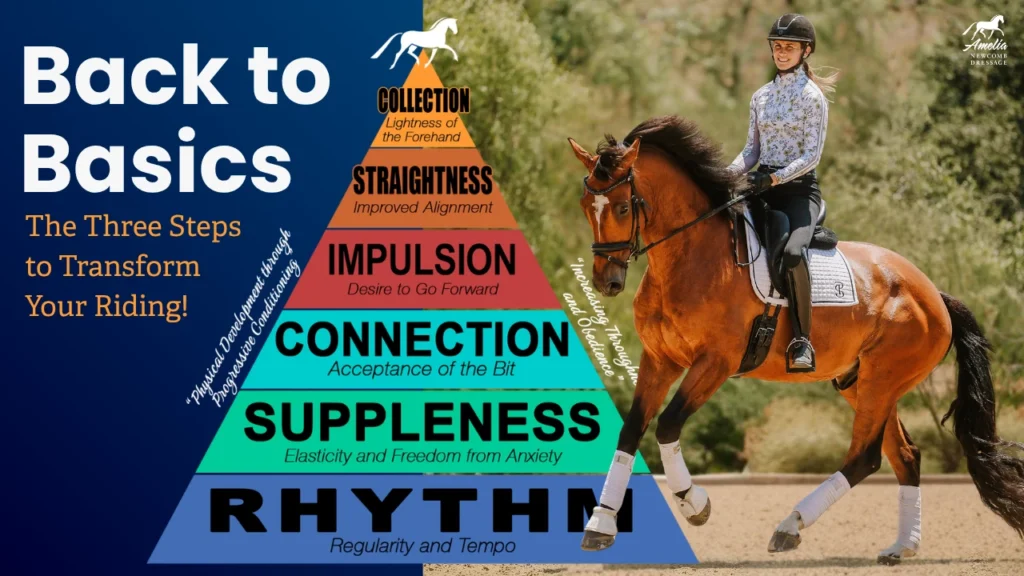
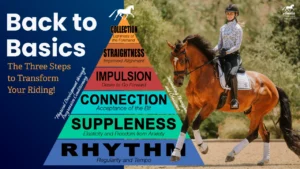
Have you ever wondered what should you be working on during your rides? The Training Scale is the tool for you! I use the Training Scale to plan every single ride – whether I’m on a 4-year-old or a Grand Prix Horse!
What Is the Dressage Training Scale?
Most of the time you spend in the saddle should be spent focusing on the base of the Training Scale: rhythm, suppleness, and connection. Even with my Grand Prix horse, I focus on these three levels of the scale for the majority of my ride because, without them, it is impossible to perform ANY movement.
You must establish rhythm, suppleness, and connection before you move on to collection (movements like shoulder-in, walk-canter transitions, flying changes, etc.). You should also keep them in mind throughout your entire ride!
How to Use the Training Scale to Plan Your Ride
A couple great exercises I like to work on to focus on the base of the Training Scale are:
Exercise 1: 20m Circles Counting the Rhythm and Suppleness
Try making one 20m circle at each end of the arena and at each mid-point (at A, E, B, and C). As you’re riding, count each stride to make your horse is going at a consistent tempo. Circles are great for both mental and physical suppleness. Mentally, they give the horse something to focus on. Physically, they help get your horse bending through their body. As you are riding, you really have to focus on bending your horse around your inside leg. When you’re bending, the aids should be inside leg on at the girth moving your horse into the outside rein, and outside leg slightly behind the girth to “catch” your horse.
Exercise 2: Trot-Canter-Trot Transitions for Connection
This is a great exercise to work on connection. When your horse has good connection, they are accepting the rein and leg, listening to your aids, and accepting the bit. With that in mind, you really want to have fluid transitions from trot to canter. It’s important to still keep rhythm and suppleness in mind as well. When I’m riding this exercise, I want to feel that my horse is elastic (suppleness) and transitions from a clear two-beat trot to a three-beat canter (rhythm). If you aren’t cantering yet, you can still focus on these same things with walk-trot-walk transitions!
When to Work on Straightness and Collection
After working on rhythm, suppleness, and connection, then you can move on to higher aspects of the Training Scale like straightness and collection. I like to work on shoulder-in and haunches-in to focus on straightness and a bit of collection. In a corner before the long side, try riding a 10m circle to set up bend for shoulder-in, and then another 10m circle at E or B, transitioning to haunches-in out of the circle.
How to Adjust the Training Scale for Young or Green Horses
If you have a young or green horse, more than likely your entire ride is focused on the base of the Training Scale. And that is okay! Each ride you should focus on what your horse needs and what parts of the Trainings Scale will most help you for that ride. There are days where I just need to focus on the basics too!
Connect and Learn with Others in a Live Setting
Don’t forget to keep an eye out for my next FREE Training Scale Webinar. I host these periodically, and we talk all about the Training Scale, how to plan your ride, resolve common training issues, and build a more productive ride from start to finish. When registration is open, reserve your seat. Even if can’t attend live, still feel free to RSVP and I’ll send you the recording. Reserving your seat is easy and we always hear amazing feedback from our students that attend.
I hope these tips help you plan your rides and give you an idea of what you should be working on with your horse!
Happy Riding!
Amelia