
















People always talk about the “rocking horse motion” of the canter, and how wonderful it is, but when you’re having difficulty mastering the motion of sitting the canter, the canter can feel less like a rocking horse and more like a car with no suspension! In this article/video, I am going to teach you how to sit the canter so you can enjoy yourself more.
In this week’s video, Stephanie Seheult is back! We’re going to explain what your seat, spine, and hips need to do in order to absorb the motion of the three canter beats and allow you to sit comfortably, then you can start to really enjoy the canter, and then be able to control it!
The canter is a three-beat gait as we know, it has an up-beat, a flatbeat, and a down-beat. To sit the canter smoothly, your hips and seat need to absorb this motion.
Mistakes that happen when you sit the Canter
Before we go into the RIGHT way, let me just tell you the wrong way to sit.
- We don’t want the Anterior Tilt. Where your pelvis rotates too far forward and you’re tipping forward. This leaves you using too many back extensors and not enough abdominal muscle.
- We also don’t want the Posterior Tilt. This is the opposite and leaves you sitting back and pushing too much. Using the wrong abdominal muscles again! (too much six-pack and not enough transverse abdominal)
The Correct Way to sit the Canter
The goldilocks of the seating positions is “Neutral spine” and this is the one we want as our base to sit the canter. In Neutral Spine there’s a slight curve in the lumbar and thoracic spines, but this is the natural shape that allows us to absorb shock in the spine. Any other shape won’t allow this!
When absorbing the canter motion with your seat, you allow the seat to move slightly on either side of the neutral spine into posterior and anterior tilt, but with the default spine being the neutral one.
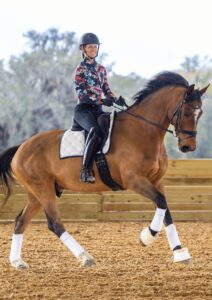
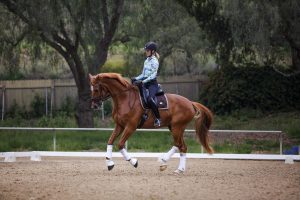
In this video, Stephanie goes into more detail on this, and Mercurio and I demonstrate the WRONG way as well as the right way!
Updated: 05/22/2026